In short: a good report card comment names one real strength, gives one example from the term and ends with one next step. Below you’ll find a formula, 150+ examples you can adapt by subject and situation, the words to avoid, and what the rest of a report card should show.
Report card comments are the part of the report parents read first and remember longest. Marks tell them how their child did. Comments tell them why, and what to do next.
Writing 35 personal comments for every subject, every term, is hard. This guide gives you a simple formula and more than 150 examples, grouped by situation and by subject. Adapt them: change the detail, add an example from your class, and make each one about the child in front of you.
All the examples use [Name] and “they” so you can fit them to any student. Every comment here is under 250 characters, so it fits on a report card alongside the marks.
The three-part formula
Strength + evidence + next step.
- Strength: something specific the student does well. “[Name] explains their thinking clearly in maths.”
- Evidence: one example from this term. “Their fractions project showed three different methods.”
- Next step: one thing to work on, and how. “Next term, [Name] should check answers before handing work in.”
Put together: “[Name] explains their thinking clearly in maths; their fractions project showed three methods. Next term, they should check answers before handing work in.”
Words that help, and words to avoid
| Instead of… | Try… |
|---|---|
| good, nice | specific: careful, creative, accurate, thoughtful |
| lazy | is still building the habit of finishing work |
| weak at | is developing their skills in |
| talks too much | is learning when to share ideas and when to listen |
| can’t | is not yet able to… and is working on it |
| always / never | often, at times, this term |
| better than the others | (don’t compare with other students) |
Describe what the student does, not who they are. “[Name] often hands work in late” can change. “[Name] is disorganised” sounds permanent.
Strengths and achievement
- [Name] understands new ideas quickly and uses them confidently in new problems.
- [Name] produces careful, accurate work and takes pride in presenting it well.
- [Name] asks thoughtful questions that help the whole class understand more.
- [Name] has shown excellent understanding of this term’s topics, as their test results show.
- [Name] applies what they learn in one subject to others, which shows real understanding.
- [Name] reads instructions carefully and completes tasks independently.
- [Name] explains their reasoning clearly, both in writing and when speaking.
- [Name] goes beyond what is asked, often researching topics further at home.
- [Name] has a creative approach to problems and is happy to try more than one method.
- [Name] set a high standard this term and met it consistently.
- [Name] remembers and uses key vocabulary accurately.
- [Name] is a confident learner who is ready for more challenging work.
Progress and improvement
- [Name] has made strong progress this term, especially in [topic].
- [Name]’s confidence has grown, and they now share answers in class.
- [Name] has worked hard on their weaker areas, and it shows in their recent work.
- [Name]’s written work is neater and better organised than at the start of the term.
- [Name] now completes tasks with less help and is becoming more independent.
- [Name] improved their test score in [subject] from [x] to [y]. Well done.
- [Name] has started to check their work, and their accuracy has improved.
- [Name] is using feedback well; their second drafts are much stronger.
- [Name] has settled well into the class and is now taking part fully.
- [Name] has turned a difficult start to the term into a steady finish.
- [Name]’s reading has improved, and they now read longer texts with confidence.
- [Name] has built good habits this term. Keeping them up will bring further progress.
Needs more support
- [Name] is still developing their understanding of [topic]. Short daily practice at home will help.
- [Name] works best with clear steps. Breaking tasks into smaller parts will help them succeed.
- [Name] understands ideas in class but finds it hard to show this in tests. Practice papers will help.
- [Name] is building confidence with [skill]. Encouragement at home makes a real difference.
- [Name] sometimes rushes. Slowing down to check work will raise their marks.
- [Name] would benefit from asking for help as soon as something is unclear.
- [Name] is working hard but finds [topic] difficult. We will give extra practice next term.
- [Name] needs to learn key facts by heart, such as [times tables / formulas], to work faster.
- [Name]’s ideas are good; the next step is to write them down in full sentences.
- [Name] can do more than they show at present. Setting small goals each week will help.
- [Name] missed some lessons this term, and catching up on [topic] is now the priority.
- [Name] is making progress at their own pace. Regular reading at home will support them.
Effort and work habits
- [Name] always tries their best, even when the work is difficult.
- [Name] completes homework on time and to a high standard.
- [Name] is well organised and comes to lessons prepared.
- [Name] keeps going when a problem is hard, which is a real strength.
- [Name] uses class time well and stays focused on the task.
- [Name] would make more progress by handing homework in on time.
- [Name] starts tasks well but needs to work on finishing them.
- [Name] is learning to manage their time across several pieces of work.
- [Name] takes care with presentation, and their books are a pleasure to read.
- [Name] could aim higher; they are capable of more detailed answers.
- [Name] is building the habit of reviewing notes after each lesson.
- [Name] responds well to targets and works steadily towards them.
Behaviour and attitude
- [Name] is polite, kind and a positive member of our class.
- [Name] follows class routines well and is a good example to others.
- [Name] shows respect to classmates and adults alike.
- [Name] is learning to wait their turn and listen to others.
- [Name] is enthusiastic, and is learning to channel that energy into their work.
- [Name] takes responsibility for their actions and learns from mistakes.
- [Name] can be distracted by others. Choosing a seat away from distractions has helped.
- [Name] has made good progress in following class rules this term.
- [Name] is honest and fair, and others trust them.
- [Name] is learning to stay calm when things don’t go their way.
- [Name] is always ready to help classmates who are finding work hard.
- [Name] brings a positive attitude to school every day.
Social skills and teamwork
- [Name] works well in a group and makes sure everyone is included.
- [Name] is a natural leader who encourages others.
- [Name] listens to other points of view and builds on them.
- [Name] has made new friends this term and is more confident with classmates.
- [Name] is learning to share ideas in group work instead of working alone.
- [Name] is a reliable team member who does their share.
- [Name] is learning to accept other ideas when the group decides differently.
- [Name] speaks confidently in front of the class.
- [Name] supports younger students well, for example during [event].
- [Name] is becoming more confident about joining in class discussions.
Attendance and punctuality
- [Name]’s attendance has been excellent this term, which has supported their progress.
- [Name] has missed [x] days this term. Regular attendance will help them keep up.
- [Name] often arrives late, missing the start of lessons. Arriving on time will help.
- [Name] has caught up well after their absence.
- [Name]’s punctuality has improved this term. Thank you for your support at home.
Mathematics
- [Name] has a strong grasp of number facts and uses them quickly.
- [Name] explains their working clearly, so it’s easy to see how they reached an answer.
- [Name] solves word problems by choosing the right operation.
- [Name] is confident with fractions and decimals and can convert between them.
- [Name] needs more practice with [times tables / long division] to build speed.
- [Name] understands the method but makes careless errors. Checking answers will help.
- [Name] is becoming confident with algebra and can solve simple equations.
- [Name] reads graphs and tables accurately and draws sensible conclusions.
- [Name] enjoys a challenge and is ready for harder problem-solving tasks.
- [Name] should show all steps of their working, even when the answer seems obvious.
- [Name] has improved their understanding of measurement and units.
- [Name] uses mathematical vocabulary correctly when explaining.
English and languages
- [Name] reads fluently and with good expression.
- [Name] writes interesting stories with a clear beginning, middle and end.
- [Name] uses a wide range of vocabulary in their writing.
- [Name] understands what they read and can explain the main ideas.
- [Name] should use full stops and capital letters consistently.
- [Name] speaks clearly and confidently in class discussions.
- [Name] is building their vocabulary. Reading every day will help.
- [Name] plans their writing well before starting.
- [Name] spells most common words correctly; the next step is longer words.
- [Name] can write for different purposes, such as letters, reports and stories.
- [Name] listens carefully and follows spoken instructions well.
- [Name] is growing in confidence when speaking in [second language].
- [Name] should read their writing back to check that it makes sense.
Science
- [Name] makes careful observations and records results accurately.
- [Name] asks good questions and makes sensible predictions.
- [Name] plans fair tests and explains why they are fair.
- [Name] uses scientific vocabulary correctly.
- [Name] can explain the results of an experiment and what they show.
- [Name] works safely and sensibly during practical work.
- [Name] is developing their understanding of [topic]. Revising key terms will help.
- [Name] draws clear, labelled diagrams.
- [Name] links science to everyday life, which shows real understanding.
- [Name] should write conclusions in full, using the evidence they collected.
Social studies, history and geography
- [Name] understands how events in the past affect our lives today.
- [Name] uses maps confidently to find and describe places.
- [Name] compares sources and notices when they disagree.
- [Name] has a good knowledge of key dates and events.
- [Name] presented their project on [topic] clearly and with good detail.
- [Name] should add more evidence to support their answers.
- [Name] shows real interest in other cultures and countries.
- [Name] is learning to write longer answers that explain causes and effects.
ICT and computing
- [Name] uses technology confidently and responsibly.
- [Name] can write simple programs and fix errors in them.
- [Name] creates clear presentations and documents.
- [Name] understands how to stay safe online.
- [Name] helps classmates with technical problems.
- [Name] should plan their work before starting on the computer.
- [Name] is learning to search for information and check that it is reliable.
Art, music and creative subjects
- [Name] shows creativity and imagination in their artwork.
- [Name] uses colour and shape with real care.
- [Name] has developed good technique with [paint / pencil / clay].
- [Name] sings with confidence and keeps in time.
- [Name] performs with enthusiasm and enjoys sharing their work.
- [Name] is learning to take more time to add detail to their work.
- [Name] is willing to try new materials and ideas.
- [Name] gives thoughtful feedback on other students’ work.
Physical education and sport
- [Name] takes part enthusiastically in every PE lesson.
- [Name] shows good teamwork and sportsmanship.
- [Name] has improved their skills in [sport] this term.
- [Name] follows safety rules and instructions carefully.
- [Name] encourages teammates and accepts results with good grace.
- [Name] is building stamina and should keep active outside school.
- [Name] is learning to try new activities with confidence.
Religion, values and wellbeing
- [Name] shows respect for different beliefs and traditions.
- [Name] thinks carefully about right and wrong in our discussions.
- [Name] shows kindness and care for others.
- [Name] is learning to talk about their feelings and ask for help.
- [Name] takes part thoughtfully in class reflections.
Kindergarten and early years
- [Name] has settled happily into school and enjoys our daily routines.
- [Name] recognises letters and is beginning to match them with sounds.
- [Name] counts objects to [10 / 20] with confidence.
- [Name] plays well with others and is learning to share.
- [Name] is becoming more independent, for example putting on their shoes.
- [Name] holds a pencil correctly and is starting to write their name.
- [Name] listens well at story time and joins in with songs.
- [Name] is learning to follow two-step instructions.
End of year
- [Name] has had a successful year and is well prepared for [next grade].
- It has been a pleasure to teach [Name] this year. They should be proud of their progress.
- [Name] has grown in confidence this year and is ready for new challenges.
- Over the holidays, reading every day will help [Name] start next year strongly.
- [Name] has worked hard all year. Keeping up good habits will help in [next grade].
- [Name] has made real progress in [subject] this year. Well done.
- [Name] is ready for the next grade. Practising [skill] over the holidays will help.
What a good report card shows
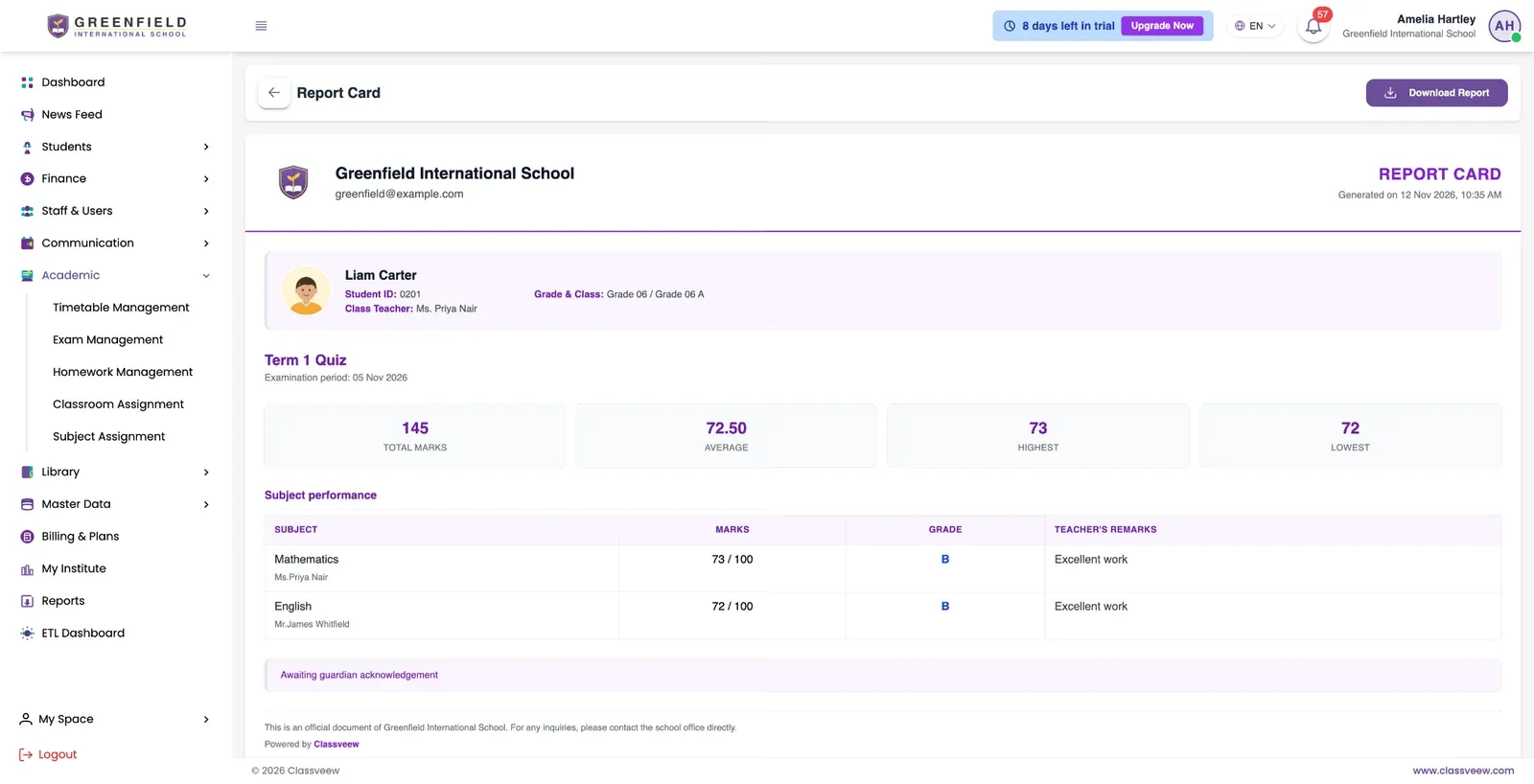
Comments sit inside the report card, and the rest of it matters too. A clear report card has:
| Part | Why it matters |
|---|---|
| School name and logo | Parents know it is official |
| Student name, ID, grade, class and class teacher | No mix-ups between students |
| The exam or term | Parents know which period it covers |
| Each subject’s mark and letter grade | The result at a glance |
| The teacher’s remark for each subject | The why and the next step |
| Total, average, highest and lowest marks | How the student did overall, and the range in the exam |
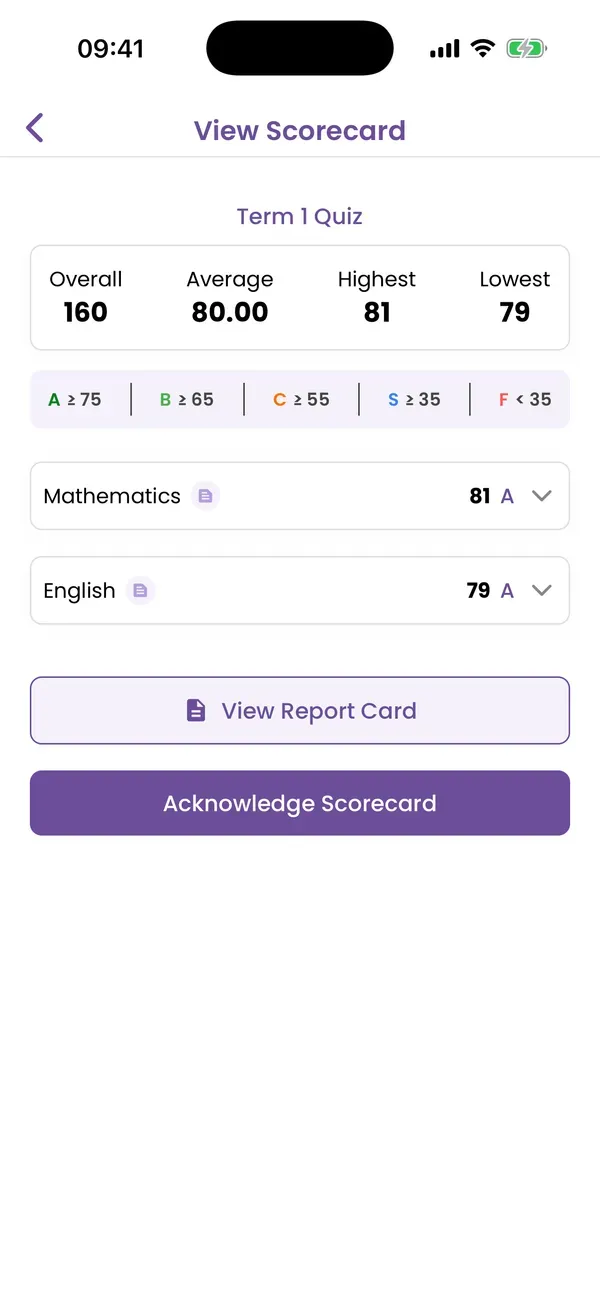
| The grading scale | So parents understand the letters |
A common grading scale
Many schools turn marks into letter grades. Here is the scale Classveew report cards use:
| Grade | Marks |
|---|---|
| A | 75 and above |
| B | 65 to 74 |
| C | 55 to 64 |
| S | 35 to 54 |
| F | Below 35 |
Writing comments faster without making them generic
- Write the strength first, for the whole class. It’s the easiest part and gets you going.
- Keep a note during the term. One line per student per month makes evidence easy to find.
- Use the examples as starters, not endings. Add one detail only you know.
- Read three comments aloud together. If you can’t tell which student each is about, add more detail.
- Let the system do the maths. Totals, averages and grades should never be typed by hand.
How report cards work in Classveew
In Classveew, teachers don’t type report cards at all. They enter marks once, and the report card is made for them.
- The marking teacher enters each score out of 100 with a remark of up to 250 characters, on the web portal or in the teacher app. Online exam papers mark multiple-choice questions automatically.
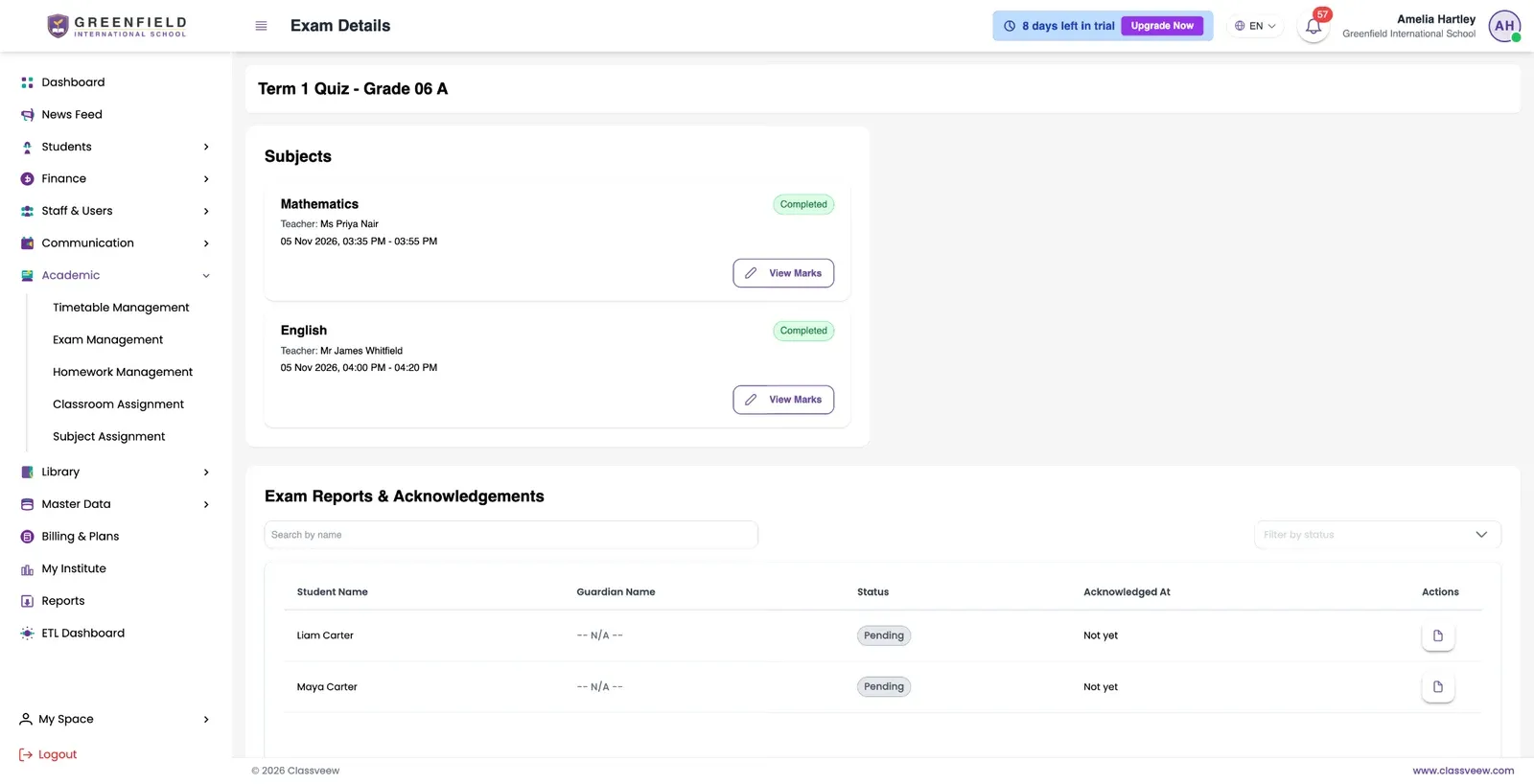
- When every subject is marked, the school releases the scores. Until then, parents see “not released”.
- Classveew builds a report card for each student, with the school’s logo and details, the student’s ID, grade, class and class teacher, each subject’s mark, grade and remark, and the total, average, highest and lowest marks.
- Parents get a notification and open the report card PDF in the app or on the web.
- Parents acknowledge the results in the app, and the school sees who has. Those who haven’t get a reminder.
See Exams and report cards, or the Help Center guides on entering exam marks and report cards.